Chess Master - Real-Time Multiplayer Chess Platform
Play chess with AI and friends in real-time
System Design & Network Topology
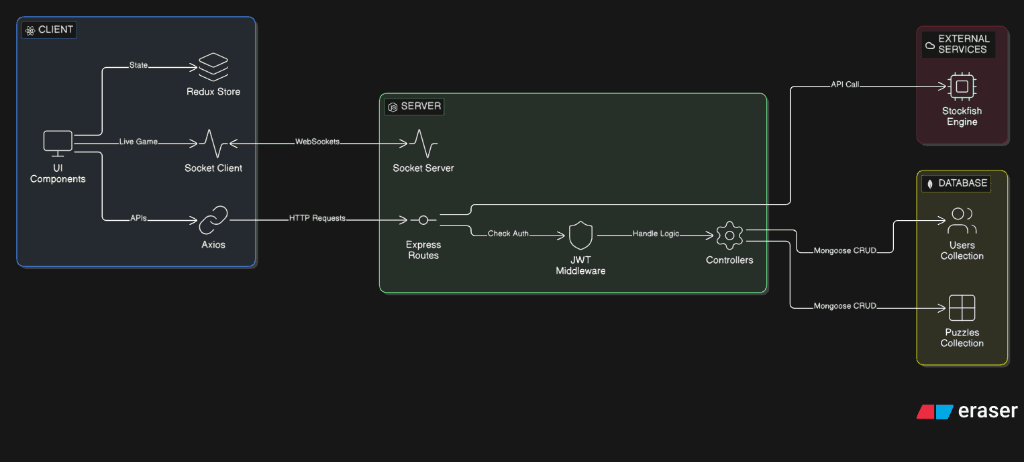
“React Chess is a full-stack real-time multiplayer chess platform featuring automated matchmaking and deep engine analysis. By compiling Stockfish into client-side Web Workers, I eliminated cloud computation costs entirely, delivering depth-25 engine evaluations with zero latency and no server overhead.”
Real-time multiplayer chess platforms often suffer from high cloud compute bills and backend freezes when running CPU-intensive chess engine evaluations. React Chess solves this by combining global Socket.IO multiplayer with zero-cost, client-side Stockfish Web Workers and instant FEN game analysis.
React + Vite frontend manages user interactions and game board rendering via chessboardjs, while chess.js acts as the single source of truth for move validation. The Node.js/Express backend handles JWT authentication, Google OAuth, and match records in MongoDB. Socket.IO manages matchmaking queues and bidirectional move broadcasting, while Stockfish runs in isolated client Web Workers.
Core Engineering Responsibilities & Contributions
Real-Time Matchmaking
Engineered a Socket.IO queue mechanism that pairs pending players, assigns colors, and synchronizes algebraic moves across global clients.
Stockfish Web Worker Pipeline
Implemented an asynchronous client-side engine pipeline utilizing Stockfish Web Workers to analyze FEN strings up to Depth 25 without blocking the main UI thread.
Decoupled State Architecture
Separated game logic and rule enforcement (chess.js) from presentation (chessboardjs) and synchronized moves via Redux.
Database & Match Records
Designed MongoDB schemas for player profiles, rating records, and PGN match histories.
Key Architectural Decisions & Trade-Offs (Why X over Y)
Why Web Workers for Stockfish?
Running chess engine calculations on a central Node.js server for thousands of concurrent players would crash server CPU. Web Workers offload 100% of compute to client browser threads with zero cloud cost.
Why Socket.IO over HTTP Polling?
Chess requires sub-100ms responsiveness. WebSockets maintain persistent TCP sockets eliminating round-trip HTTP overhead.
Why decouple chess.js and chessboardjs?
Direct DOM manipulation is brittle. chess.js acts as authoritative validator while chessboardjs purely reflects FEN state.
Production Challenges & How They Were Solved
Main Thread UI Freezes at High Evaluation Depths
Offloaded Stockfish computations to dedicated Web Workers via postMessage, streaming back evaluation scores, principal variations (PV), and depth without dropping UI frames.
Multiplayer Board State Desynchronization
Enforced strict local chess.js validation before updating UI and handled Socket.IO disconnect events gracefully to notify opponents.
Scalability & 100k Concurrent Users Roadmap
- 01.Introduce Redis Pub/Sub (Socket.IO Redis Adapter) to scale WebSocket gateways horizontally across multiple Node.js instances.
- 02.Persist live match states in Redis memory to allow instant match resumption upon browser refresh.
- 03.Implement an Elo / Glicko-2 matchmaking ranking system.
Key System Highlights
- Sub-100ms latency with WebSockets
- Stockfish AI (2800 ELO rating)
- Secure JWT authentication
- Real-time multiplayer gameplay